

Before You Say I Do, Read This
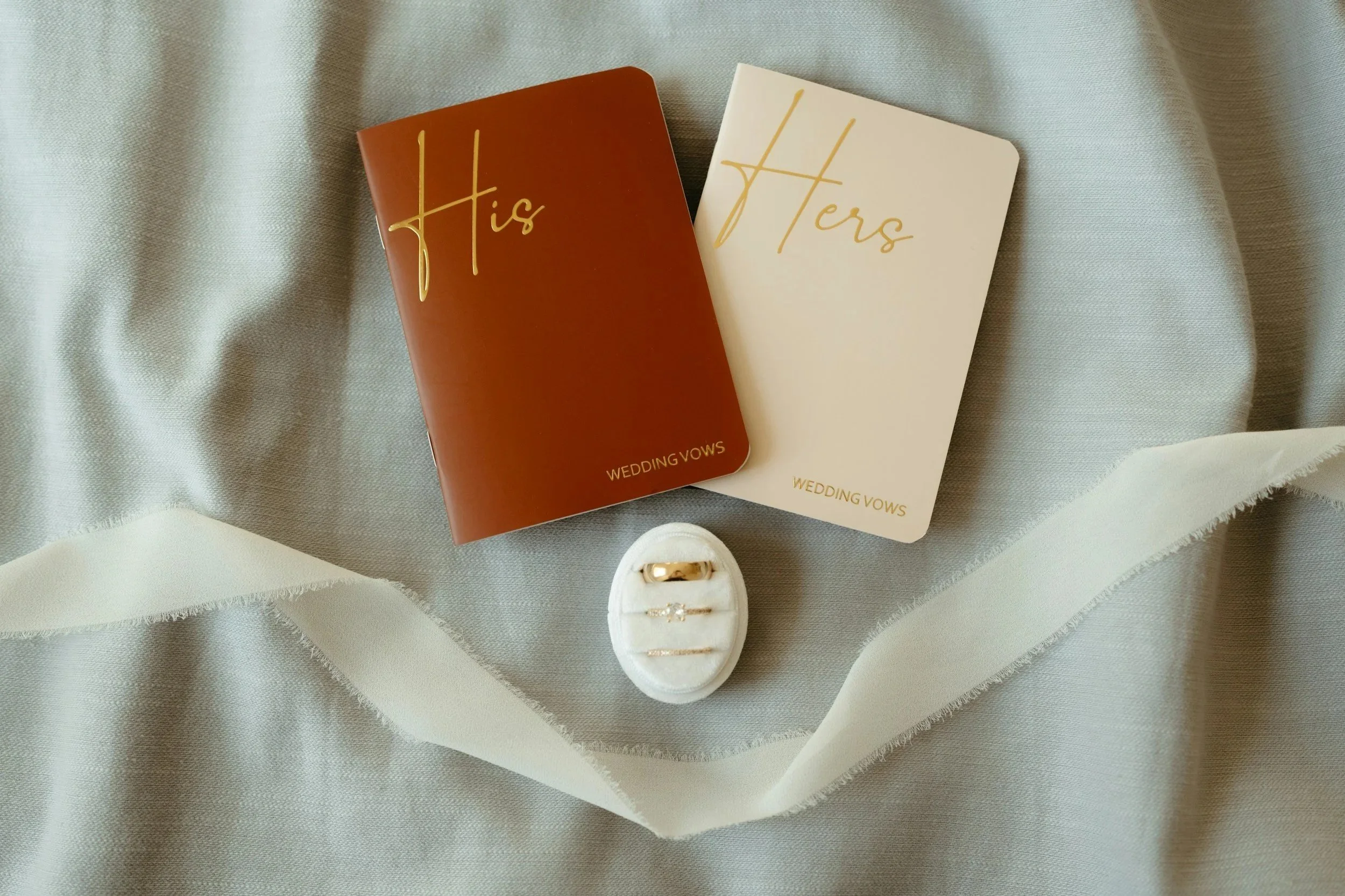
You Don't Have to Be a Writer to Write Vows That Make Your Partner Cry
This blog is dedicated to vows. It’s the thing I feel makes a wedding, a wedding. Your vows are the promises, the commitments you’ve made, being given wings and being told to fly.
You've found the venue. You've picked the flowers. You've stress-tested seventeen different seating arrangements. And then someone asks: "So, have you written your vows yet?"
And suddenly the whole wedding feels very, very difficult.
Here's the truth: writing your own vows is one of the most meaningful things you can do on your wedding day - and also one of the most unnecessarily terrifying. So let's take the mystery out of it.
First up: do you actually have to write your own vows?
No. And no one should make you feel bad about that.
In New Zealand, the only legal requirement is that you each say the words "I take you [name] to be my lawful wedded spouse" (or similar). That's it. Everything else - the promises, the love letter, the inside jokes - is completely optional.
Some couples choose traditional vows. Some write something entirely from scratch. Many land somewhere in between: a classic structure with a few personal lines folded in.
There's no right answer. Only the answer that feels like you.
So why do people write their own?
Because the ceremony is the one part of your wedding day that no one else experiences the same way you do. The flowers look beautiful, but they fade. The speeches are mostly for the guests. Your vows? That's just you, your person, and a room full of people sobbing trying not to cry.
When a couple writes their own words - imperfect, honest, a little wobbly - something shifts in the room. People feel it. You feel it.
That's what we're going for.
When I said my vows at my wedding the thing I remember the most was us laughing at the fact that we’d both promised to keep each other fed, since hangry was a state we found ourselves in far too often. It was sweet, it was funny and most of all it etched a memory that will last a lifetime. AI couldn’t have known that level of detail about us, nor could the generic articles that give you vows where you just have to chop and change the names and the sentences around.
So go ahead, write your own. As long as your heart is in it, you’ll nail it for sure.
Where most people get stuck
They think they need to be eloquent.
You don't. The best vows I've witnessed weren't polished, they were true. They were windows into their relationships, as messy and complicated as life can be. Moments of grief, shared experiences of Bali belly, and admitting to each other their deepest vulnerabilities knowing their partner would be there to pick up the pieces.
They try to write it like a speech.
Vows aren't a speech. You're not addressing the crowd, you're talking to one person. Write it like you'd say it out loud to them on a Tuesday afternoon.
They wait until the week before (or the night before).
Please don't, mainly because it stresses you out when you should be excited. Give yourself at least three to four weeks. Write a messy first draft. Leave it. Come back. You'll know when it's right.
A simple framework to get you started
If you're staring at a blank page, try this:
Why this person? Not the generic reasons. The specific ones. What do they do that no one else does?
A moment that said everything. Think of one memory where you thought, yes, this is it. Tell that story in two or three sentences.
What you're promising. Be real. Be specific. "I promise to always make you a cup of tea before bed" will land harder than "I promise to love you through all of life's challenges."
The finish line. End with something that looks forward. Where are you headed together? What are your future plans or goals?
You don't need all four. Even one or two, done well, is enough.
How long should they be?
Somewhere between one and two minutes when spoken aloud. That's roughly 150-250 words, or half a piece of paper. Any longer and you're writing a memoir. Any shorter and - actually, shorter is usually fine. Less is almost always more.
Read them out loud to yourself. If you're stumbling, simplify. If you're rushing, slow down.
A few things that always work
Specific details over general statements ("the way you laugh at your own jokes before you even get to the punchline" beats "your sense of humour")
Permission to be a little funny, as long as the heart is there underneath
Ending on a line that lands - something they'll remember when you're eighty
And a few things to avoid
Write yourself an opening line and practise it - this will help
Apologising for your vows during your vows ("I'm not great with words, but...")
Making promises you can't keep (no one has ever successfully promised to always be calm in an argument, and no one ever wants to be told to calm down when they’re arguing anyway)
Do your vows have to match your partner's?
Not even a little bit, not in length, tone, or style. You're two different people. Yours can be funny and theirs can be heartfelt. What’s more important is that they’re true, honest, and deeply yours.
If you're writing them separately - which many couples do - consider agreeing on a rough length and whether you'll include humour. That way you're not standing there having written a poem while your partner's pulled out three pages of dot points.
One last thing
Many couples struggle with what they want to say. The ones who struggle most are usually the ones who are trying to write something impressive. The ones who nail it are the ones who decide to just be honest.
You know this person. You know why you're marrying them. Start there.
If you'd like some help thinking through your ceremony - vows and all - I'd love to hear from you. Get in touch and let's have a chat about what would make your day feel like yours.